

Emergency Lighting Testing Requirements QLD
A power failure is not the time to find out whether an exit sign has a flat battery. Emergency lighting testing requirements are designed to make sure people can see exit paths, changes in level and essential safety equipment when normal lighting fails. For commercial property owners and managers, regular testing is a practical part of keeping a building safe and ready for inspection.
Emergency lights are easy to overlook because they sit quietly in the background. But a failed fitting, damaged diffuser, ageing battery or missing test record can create a serious issue during an emergency - and may leave the person responsible for the building facing compliance concerns.
What emergency lighting is required to do
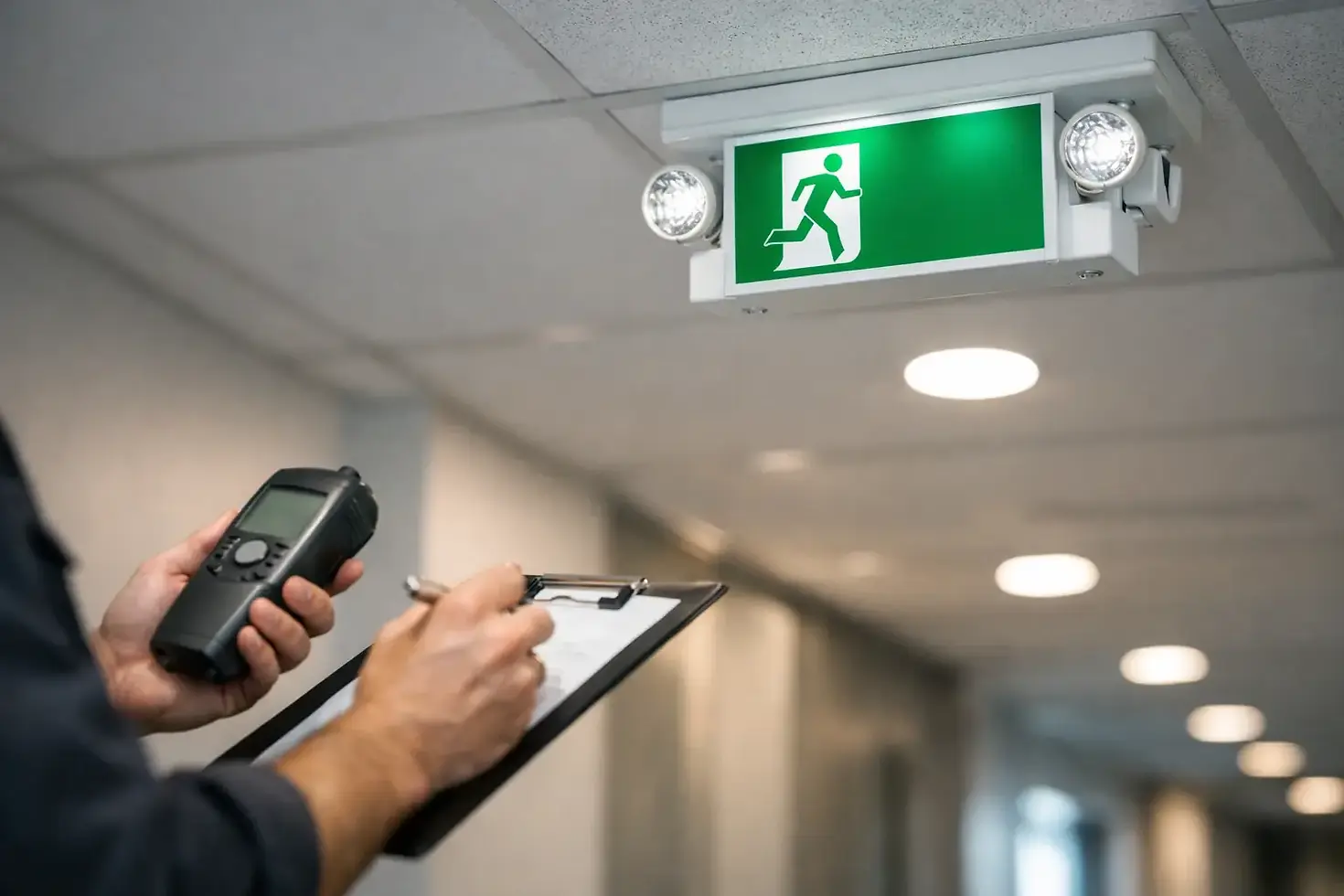
Emergency lighting provides temporary illumination after the normal electrical supply fails. It commonly includes illuminated exit signs and emergency luminaires installed along evacuation routes, near exits, at stairways, in corridors, and in open areas where people need to find a safe way out.
The system is usually found in commercial buildings, common areas of multi-residential properties, public facilities, workplaces and some specialised sites. The exact layout depends on the building's classification, use, size and approved fire safety design. A small tenancy and a large warehouse will not necessarily have the same arrangement or maintenance needs.
In Queensland, emergency lighting systems are generally designed, installed and maintained in line with the National Construction Code and relevant Australian Standards, including the AS/NZS 2293 series. These documents set expectations for emergency escape lighting and exit signs. Building approvals, fire safety schedules and insurer requirements can also affect what applies to a particular property.
Emergency lighting testing requirements explained
For most maintained emergency lighting systems, testing is not a once-a-year job. AS/NZS 2293.2 sets out routine inspection and maintenance practices, including periodic discharge testing at intervals not exceeding six months.
During a discharge test, the normal supply to the emergency fittings is simulated as unavailable. The lights and exit signs must operate from their emergency power source for the required duration, which is commonly 90 minutes. At the end of the test, fittings should still provide adequate illumination and signs should remain visible.
This is more than checking whether a green indicator light is on. A fitting can look normal while its battery no longer holds enough charge. The test also gives a technician an opportunity to identify damaged housings, poor lamp or LED performance, loose components, blocked signs and faults with the charging circuit.
Routine visual checks between formal tests
A responsible person may choose to arrange more frequent visual checks, particularly in busy premises, schools, accommodation buildings or sites where fittings are exposed to damage. These checks can confirm that exit signs are illuminated, emergency fittings have not been painted over or obstructed, and visible damage is dealt with promptly.
Visual checks do not replace the required functional testing. They are simply a sensible way to catch obvious problems before the next scheduled test.
Why the 90-minute test matters
The required operating period allows time for occupants to evacuate safely and for emergency response procedures to begin. If a light cuts out after 15 or 30 minutes, it cannot be relied upon when conditions are at their most difficult.
Battery condition is the most common reason for failure, but it is not the only one. Older fittings may have degraded electronics, and newer LED emergency lights can still develop charging or control faults. Replacing a failed battery may be suitable in some fittings, while a complete replacement can be safer and more cost-effective where units are old, damaged or no longer compatible with available parts.
Keep a clear emergency lighting logbook
Testing is only useful if there is evidence it was completed and any faults were acted on. A maintenance logbook should record the date of each inspection and discharge test, the areas or fittings tested, defects found, repairs completed and the name of the person or contractor who carried out the work.
For property managers, this record provides continuity when tenants change or a building is sold. For business owners, it makes compliance checks less stressful because the maintenance history is available rather than relying on memory or scattered invoices.
A good record should also identify any fitting that could not be repaired immediately and explain what temporary action was taken. Leaving a failed exit sign unrecorded is not a solution. If a replacement is needed, it should be organised without unnecessary delay.
Who is responsible for testing?
Responsibility can depend on the lease arrangement and the type of premises. In many commercial properties, the building owner is responsible for base-building emergency systems, while tenants may have obligations for fittings inside their leased area. In shared buildings, a body corporate or facilities manager may coordinate maintenance for common areas.
The safest approach is to make responsibilities clear in writing. Do not assume another party is arranging testing because they handle the fire extinguishers or general cleaning. Emergency lighting, fire detection, emergency exits and evacuation plans are related safety measures, but they may be managed under different service arrangements.
Electrical testing, repairs and replacement work should be carried out by appropriately qualified professionals. A licensed electrician can assess the fitting, test its operation, identify the cause of failure and install compliant replacements where needed.
Common problems found during testing
Emergency lighting faults are often straightforward to fix when they are found early. The problems that cause the most trouble are the ones left until a formal inspection or an actual outage.
Common issues include:
batteries that no longer support the full emergency operating time
exit signs that are dim, damaged, incorrectly located or partially obscured
emergency lights with cracked covers, failed LEDs or faulty charging components
altered tenancy layouts that leave new corridors, doors or work areas poorly covered
missing test records and unclear responsibility for maintenance.
Renovations deserve particular attention. Moving a partition, changing a doorway or reconfiguring shelving can alter the evacuation path and block light that was previously adequate. Before a fit-out is completed, check whether emergency lighting and exit signage still suit the changed space.
When should you call an electrician?
Arrange professional help if a fitting fails its discharge test, an exit sign is not illuminated, a battery warning indicator appears, or there has been damage from water, impact or building works. It is also wise to seek advice before a commercial renovation, tenancy change or upgrade to LED lighting.
For older sites, a broader review can be worthwhile. The goal is not to replace equipment unnecessarily. It is to identify whether the current system still matches the building layout and whether ageing fittings are likely to create repeat maintenance costs. Clear advice should give you practical options, including repair, targeted replacement or a planned upgrade.
LedRex Electrical can assist Toowoomba-area property owners and businesses with reliable electrical maintenance, fault finding and lighting solutions. Regular testing takes little time compared with the disruption of a failed inspection or an unsafe evacuation route. Put the next test date in the calendar, keep the logbook up to date, and deal with faults while they are still small jobs.


Comments